Air-Dry Clay Animals
No kiln, no oven: air-dry clay lets children shape simple animals that hold their form by the next morning.
By WonderCraft Kids Editorial Team, Editorial team · Updated 1 September 2026
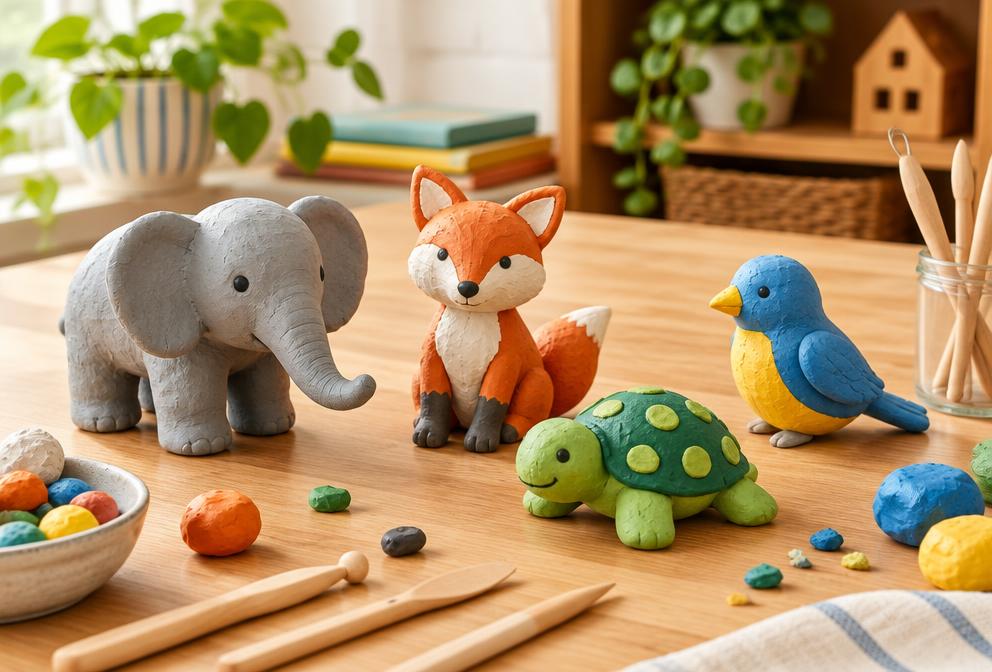
Air-dry clay behaves like a firmer, less sticky play dough that actually sets solid, so a wobbly clay elephant survives being carried around the house for a week. Children pinch, roll and press it into shape, then leave it to cure overnight before painting. Cleanup is a wipe of the table, since dried crumbs sweep up easily rather than smearing.
What you need
- 500g air-dry clay
- A rolling pin or clean glass jar
- A butter knife or clay tool for details
- A small cup of water for smoothing joins
- A board or placemat to work on
- Acrylic or poster paint for once it dries
- Toothpicks for texture and legs
Step by step
- 1
Break off a fist-sized ball of clay for the body and roll it smooth between both palms.
- 2
Pinch out smaller balls for the head, ears, tail and legs, keeping proportions roughly right for the animal in mind.
- 3
Press each piece onto the body firmly, then smooth the join with a wet fingertip so it will not crack apart.
- 4
Use a toothpick to score texture such as fur lines, scales or a wide-eyed face.
- 5
Leave the finished animal flat on a board somewhere warm and dry for 24 to 48 hours, turning it once if it seems damp underneath.
- 6
Once fully hardened and pale in colour, paint it and leave a further hour to dry.
What kids learn
Three-dimensional thinking
Building an animal from separate parts gives children a chance to practise imagining a shape before it exists.
Fine motor strength
Pinching, rolling and smoothing clay gives children an opportunity to practise controlled hand movements.
Patience over two sessions
Waiting a full day for the clay to dry before painting can help children practise working on something across more than one sitting.
Make it easier
Stick to a simple rounded animal like a hedgehog or snail, pressing in toothpicks for spikes rather than sculpting separate limbs.
Make it more challenging
Try a standing four-legged animal that balances on its own, checking the legs are thick enough to bear the body's weight before it dries.
Safety and supervision
- Air-dry clay is not food, and small pinched-off pieces are a choking risk for children who still mouth objects.
- Keep the clay tub sealed between sessions so it does not dry out before you are ready to use it.
- Clay tools with a point should be used under supervision with younger children.
Adult supervision is required for every activity on this site. Read our full child safety guidelines.
Pin this activity
A 2:3 vertical graphic, sized 1000×1500 for Pinterest. Save it for later or share it with another parent.
wondercraftkids.com
Air-Dry Clay Animals
Ages 4-8 · 30 min · low mess
Ages 4+ · Low mess
Suggested pin description
Air-Dry Clay Animals: No kiln, no oven: air-dry clay lets children shape simple animals that hold their form by the next morning. Ages 4+, 40 minutes total, low mess. Full step-by-step instructions and a materials list at WonderCraft Kids.
Free download
Get the FREE 20 Screen-Free Activities Pack
Twenty printable activity cards for ages 2–8, sorted by time and mess level. One email, no spam, unsubscribe any time.
Frequently asked questions
How long does air-dry clay actually take to harden?+
Thin pieces can be touch-dry in a day, but anything thicker than a golf ball can take two to three days to harden all the way through.
Can cracks be fixed once the clay has dried?+
Small cracks can be filled with a little water mixed into leftover clay and smoothed in, then left to dry again before painting.