Baking Soda Volcano Eruptions for Kids
Baking soda, coloured vinegar and a pipette make small, repeatable volcano eruptions — an easy, hands-on science activity for kids aged 3 to 7.
By WonderCraft Kids Editorial Team, Editorial team · Updated 5 October 2026
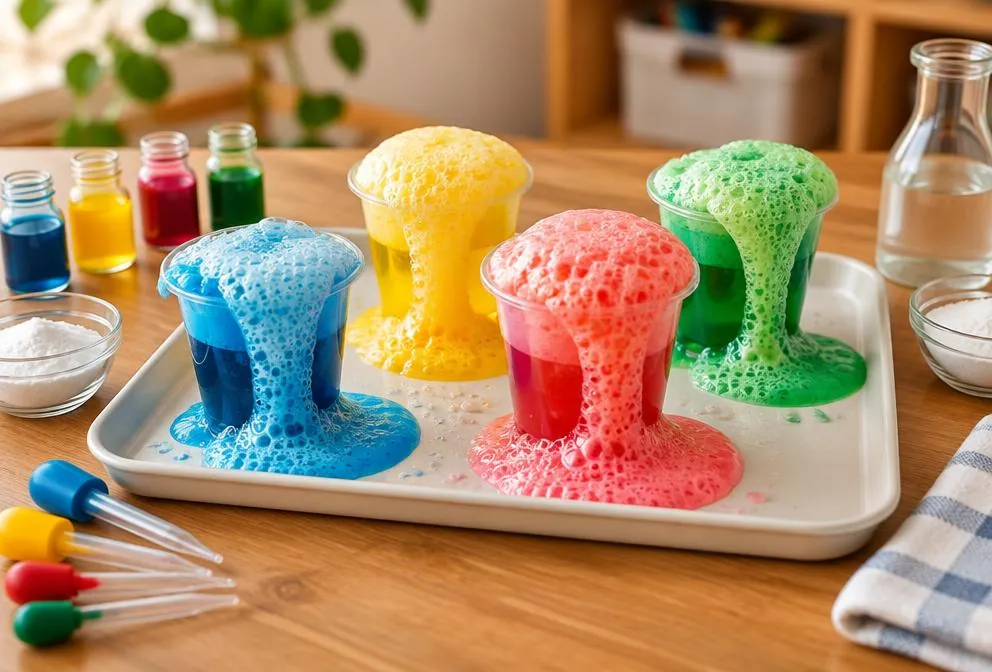
A baking soda volcano is one of the easiest science activities to do at home. Children squeeze coloured vinegar onto baking soda (bicarbonate of soda) and watch it fizz and foam up like a tiny eruption. Instead of one big papier-mâché volcano that erupts once, this version uses a tray of baking soda — or a simple volcano mound — so children aged 3 to 7 can make dozens of small, controllable eruptions themselves. It takes about 5 minutes to set up and keeps most children busy for 25 minutes or more, indoors on a tray or outside.
What you need
- About 1 cup of baking soda (bicarbonate of soda)
- White vinegar in a jug
- Pipettes, a small squeezy bottle or a teaspoon
- Food colouring or liquid watercolour
- A deep-sided baking tray or plastic storage box
- 3 small cups for the coloured vinegar
- Optional for a volcano shape: a small cup or bottle and play dough, foil or sand to build a mound around it
- Old towel or wipe-clean mat for cleanup
Step by step
- 1
Set up the tray: spread the baking soda in an even layer across the tray. For a volcano shape, stand a small cup in the middle, build a mound of play dough, foil or damp sand around it, and fill the cup with a few spoonfuls of baking soda.
- 2
Colour the vinegar: pour vinegar into three small cups and add a few drops of a different food colouring to each.
- 3
Show one squeeze: show your child how to fill a pipette and squeeze it over the baking soda. With a teaspoon, a small pour works just as well.
- 4
Let the eruptions happen: let them fizz wherever they like. The foam rises, spreads and carries the colours into each other.
- 5
Talk about what you see: ask questions such as “Where do the bubbles come from?” and “What happens if you add more vinegar?”
- 6
Keep it going: when the fizzing slows, sprinkle on more baking soda. Repeat until the vinegar runs out.
- 7
Clean up: pour the leftover liquid down the sink with plenty of water, rinse the tray and wipe the table.
What kids learn
What is happening
Vinegar is an acid and baking soda is a base. When they meet they react and make carbon dioxide gas, and the bubbles of that gas are the fizz. Children can observe a reaction happening and see that the gas is real.
Asking “what if?”
Changing one thing — more vinegar, more baking soda, a bigger squeeze — gives children a chance to make simple predictions and check what happens.
Finger control
Squeezing and releasing a pipette lets children practise small, controlled hand movements.
Make it easier
Use one colour and a spoon instead of a pipette, so every pour gives a big, instant fizz. Stand close by to help with pouring.
Make it more challenging
Build a volcano mound and try to make the tallest eruption. Test whether more baking soda, more vinegar or adding a squirt of washing-up liquid (for extra foam) changes the result, and draw what happened each time.
Safety and supervision
- Vinegar stings eyes. Keep faces back from the tray and rinse with water straight away if it splashes.
- Use white vinegar — malt and balsamic vinegar stain.
- Never seal baking soda and vinegar in a closed bottle or container; the gas builds pressure quickly.
- Supervise young children so they do not drink the coloured vinegar or eat the baking soda.
Adult supervision is required for every activity on this site. Read our full child safety guidelines.
Free download
Get the FREE 20 Screen-Free Activities Pack
Twenty printable activity cards for ages 2–8, sorted by time and mess level. One email, no spam, unsubscribe any time.
Frequently asked questions
What age is a baking soda volcano suitable for?+
Children from about age 3 enjoy squeezing the vinegar and watching the fizz with an adult nearby. Children aged 5 to 7 can start testing changes and talking about why it fizzes.
Do I need to build a volcano?+
No. A tray of baking soda gives lots of small eruptions and is easier to repeat. If your child wants a volcano shape, stand a cup inside a mound of play dough, foil or sand and add the baking soda to the cup.
Can I use lemon juice instead of vinegar?+
Yes. Lemon juice is also an acid, so it fizzes with baking soda and smells nicer, though it usually costs more.
How do I clean up afterwards?+
Pour the leftover liquid down the sink with plenty of water, rinse the tray, and wipe surfaces with a damp cloth.