Homemade Colour Mixing Lab
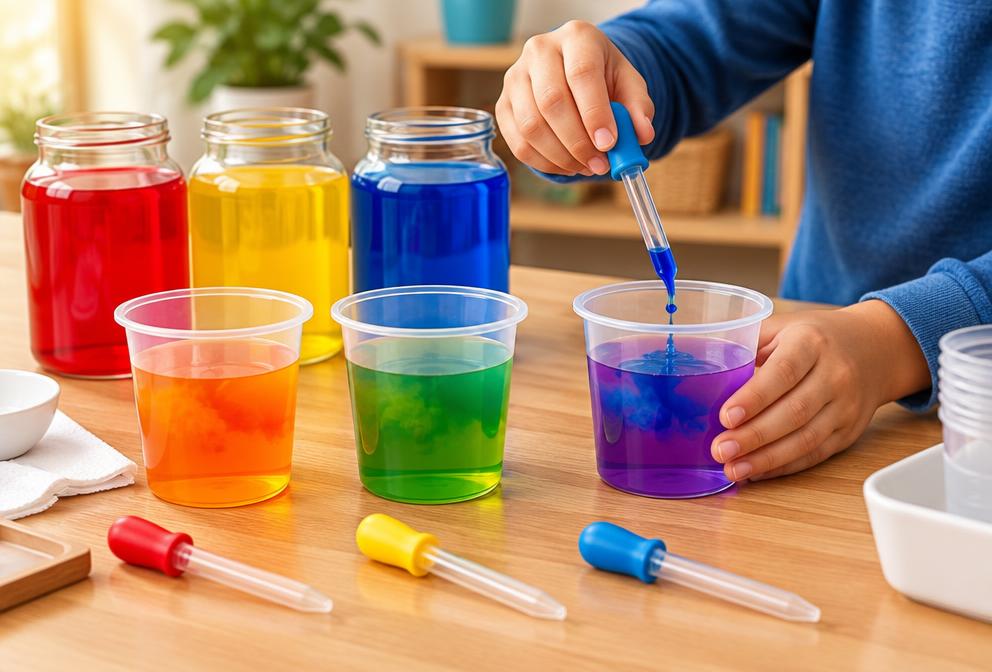
Coloured water in jars and a set of pipettes turn a kitchen table into a hands-on colour-mixing lab.
By WonderCraft Kids Editorial Team, Editorial team · Updated 7 September 2026
This turns primary-colour theory into something children mix themselves rather than being told. Small jars of red, yellow and blue water sit alongside empty jars and pipettes, and children draw up colour, drip it in and watch new shades appear. It runs longest when there is space to keep experimenting rather than one correct answer to find.
What you need
- Small clear jars or cups, at least 6
- Food colouring in red, yellow and blue
- Water
- Pipettes or droppers, one per colour plus extras
- A tray to hold everything
- A muffin tin (optional, for extra mixing wells)
Step by step
- 1
Fill three jars with water and colour each one red, yellow or blue.
- 2
Set out several empty jars or muffin tin wells alongside them.
- 3
Give your child a pipette for each primary colour.
- 4
Let them draw up colour and drip combinations into the empty containers.
- 5
Ask them to predict what colour will appear before each mix, then check.
- 6
Keep a note or photo of any mixes worth remembering, since exact ratios are hard to repeat.
What kids learn
Colour theory
Mixing primary colours themselves gives children a chance to discover secondary colours rather than memorising them.
Fine motor control
Squeezing a pipette to draw up and release liquid gives children an opportunity to practise controlled hand movements.
Scientific prediction
Guessing outcomes before testing them can help children practise forming and checking a hypothesis.
Make it easier
Use just two colours at a time so the outcome is easier to predict and understand.
Make it more challenging
Introduce measured drops, such as three of red to one of yellow, and compare how ratios change the shade.
Safety and supervision
- Food colouring can stain skin, clothing and surfaces, so work over a tray and use an apron.
- Coloured water is not for drinking; supervise closely with children who might taste it.
- Keep glass jars for older children only and use plastic cups for younger ones.
Adult supervision is required for every activity on this site. Read our full child safety guidelines.
Pin this activity
A 2:3 vertical graphic, sized 1000×1500 for Pinterest. Save it for later or share it with another parent.
wondercraftkids.com
Homemade Colour Mixing Lab
Ages 3-7 · 25 min · low mess
Ages 3–7 · Low mess
Suggested pin description
Homemade Colour Mixing Lab: Coloured water in jars and a set of pipettes turn a kitchen table into a hands-on colour-mixing lab. Ages 3–7, 35 minutes total, low mess. Full step-by-step instructions and a materials list at WonderCraft Kids.
Free download
Get the FREE 20 Screen-Free Activities Pack
Twenty printable activity cards for ages 2–8, sorted by time and mess level. One email, no spam, unsubscribe any time.
Frequently asked questions
Why does my mixed colour look muddy instead of bright?+
Too many colours combined at once tends to produce brown or grey; encourage mixing just two colours per container for cleaner results.
Can we save the mixed colours?+
Coloured water does not keep well and will fade or grow cloudy after a day or two, so treat it as a same-day activity.