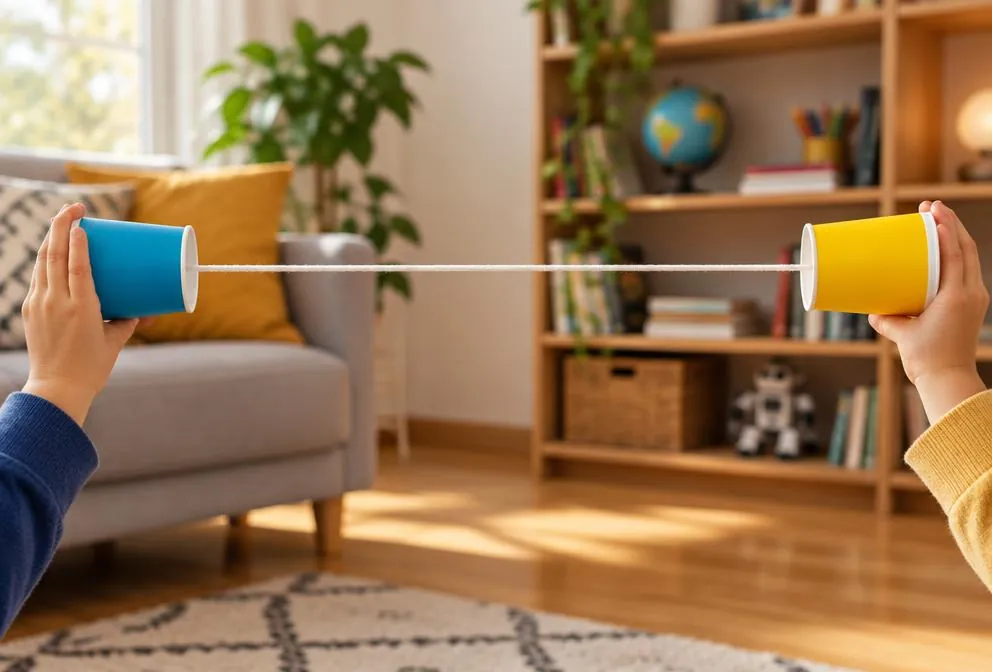
How to Make a Cup-and-String Telephone
Two paper cups and a length of string make a working cup phone — a five-minute way to show kids how sound travels.
By WonderCraft Kids Editorial Team, Editorial team · Updated 5 October 2026
A cup-and-string telephone is a simple toy phone made from two paper or plastic cups joined by a long piece of string. One person speaks into a cup, and the other hears them through the second cup when the string is pulled tight. It suits children aged 4 to 8, takes about 5 minutes to make with things you probably already have, and makes no mess. Below you will find exactly how to make one, how to use it, why the sound travels along the string, and what to check if it does not work first time.
What you need
- 2 clean paper or thin plastic cups (tin cans also work — see FAQ)
- 3-5 metres of string, kitchen twine, fishing line or thin cotton thread
- A sharpened pencil, skewer or drawing pin to make the holes (adult use)
- 2 paperclips, buttons or matchsticks to anchor the string
- Sticky tape (optional, to hold the knots)
Step by step
- 1
Make the holes: an adult pushes a pencil or skewer through the centre of the base of each cup to make a small hole — just big enough for the string.
- 2
Thread the string: push one end of the string through the base of the first cup from the outside, so the end comes out inside the cup. Do the same with the other end and the second cup.
- 3
Anchor the ends: inside each cup, tie the string around a paperclip or button so it cannot pull back through the hole. Add a piece of tape over it if you like.
- 4
Pull it tight: give one cup to each person and walk apart until the string is straight and tight. It should not touch the floor, furniture or anything else.
- 5
Talk and listen: one person speaks clearly into their cup while the other holds their cup over their ear. Then swap — take turns talking and listening.
- 6
Experiment: try letting the string go slack, pinching it in the middle, or using a longer string, and notice what changes.
What kids learn
Why the sound travels
When you speak into the cup, your voice makes the base of the cup vibrate. Those vibrations travel along the tight string to the other cup, which vibrates too and passes the sound to the listener's ear. Children can explore sound as a kind of movement.
Testing one change
Loosening the string, pinching it or changing its length lets children change one thing at a time and see how it affects the sound — an early taste of fair testing.
Taking turns to talk
Speaking, then listening, then swapping gives children a chance to practise the back-and-forth of a conversation.
Make it easier
Start with a short string, about a metre, and stand close together so it works quickly. An adult can hold the string tight while the child talks.
Make it more challenging
Compare different strings (wool, twine, fishing line) and cups (paper, plastic, tin can) and record which works best. Or join two telephones with a shared knot so three or four people can listen on one line.
Safety and supervision
- An adult should make the holes in the cups, as a pencil point or skewer can slip.
- Keep the string at a sensible length indoors and away from necks; do not run with the string stretched across a room where people could trip.
- If using tin cans, choose cans with smooth, safe-cut rims and cover edges with tape.
Adult supervision is required for every activity on this site. Read our full child safety guidelines.
Free download
Get the FREE 20 Screen-Free Activities Pack
Twenty printable activity cards for ages 2–8, sorted by time and mess level. One email, no spam, unsubscribe any time.
Frequently asked questions
Why does my cup phone not work?+
The most common reason is a slack string. Pull it tight and make sure it is not touching anything. Thick cups, very thick or stretchy string, and loose knots can also weaken the sound.
What is the best string for a string cup telephone?+
Thin, non-stretchy string works best — kitchen twine, cotton thread or fishing line. Wool is stretchy and soaks up vibrations, so the sound is quieter.
Can you make a can and string telephone?+
Yes. Clean tin cans work the same way and are often louder. An adult should make the holes with a nail and hammer, and check that rims are smooth.
How long can the string be?+
Several metres works well. Longer strings can still work if they stay tight and do not touch anything, but the sound gets fainter the further it travels.
What age is a cup-and-string telephone suitable for?+
Children from about 4 enjoy using one with adult help. From around 6 to 8, they can usually make it themselves (with an adult making the holes) and test different strings and cups.