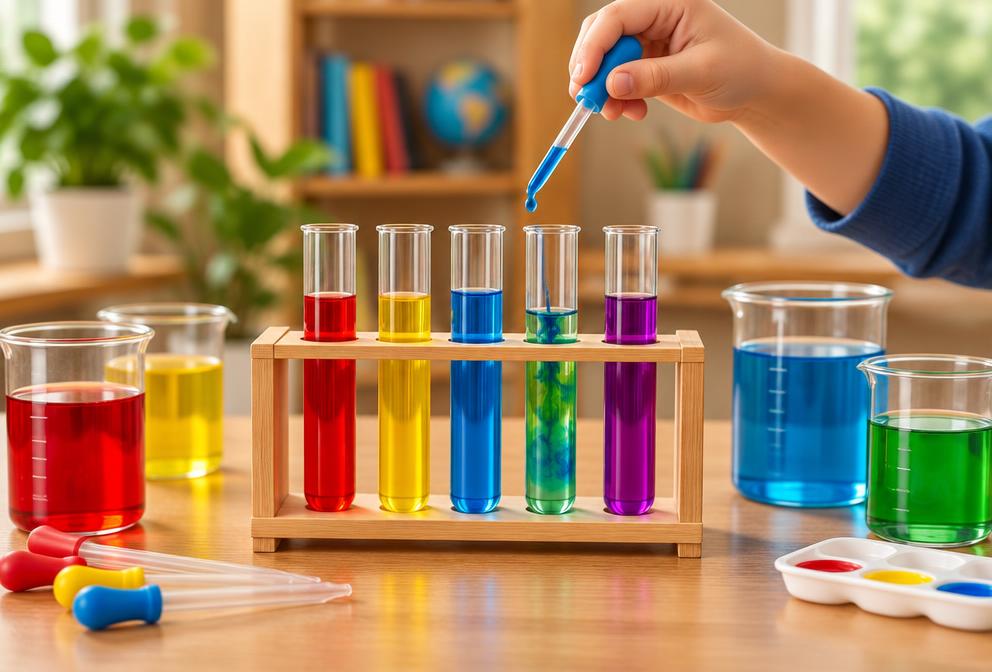
Kids Science Colour Lab
Mixing primary-coloured water, pipettes and household fizz to test what happens when colours and reactions combine.
By WonderCraft Kids Editorial Team, Editorial team · Updated 11 September 2026
A colour lab turns the kitchen table into an experiment station using nothing more exotic than food colouring, water and bicarbonate of soda. Children use pipettes or droppers to mix colours in small cups, watch them swirl and combine, then move on to a fizzing reaction that changes colour as it happens. It is genuinely open-ended: there is no single right result, only things to notice and describe.
What you need
- Small clear cups or an ice cube tray
- Water
- Red, yellow and blue food colouring
- Pipettes or droppers
- Bicarbonate of soda
- White vinegar
- A tray to contain spills
Step by step
- 1
Fill several small cups with water and add a different food colouring to each, keeping some cups as plain water.
- 2
Give your child a pipette and let them draw up colour from one cup and drip it into another to watch it mix.
- 3
Ask them to predict what red and blue will make before they try it, then compare the guess to the result.
- 4
For the fizzing stage, spoon a little bicarbonate of soda into empty cups on the tray.
- 5
Add a few drops of coloured vinegar to each cup and watch it fizz and change colour as it reacts.
- 6
Let them keep testing combinations, topping up bicarbonate and vinegar as needed.
What kids learn
Predicting and testing
Guessing a colour result before mixing gives children a chance to practise forming and checking a simple hypothesis.
Cause and effect
Watching vinegar meet bicarbonate can help children practise connecting an action directly to its reaction.
Careful, controlled movements
Squeezing a pipette to release an exact number of drops trains fine motor precision.
Make it easier
Stick to colour mixing only, using large squeezy bottles instead of pipettes for easier little hands.
Make it more challenging
Introduce measuring spoons and ask your child to test whether more bicarbonate makes a bigger or smaller fizz, recording results in a simple chart.
Safety and supervision
- This reaction uses only bicarbonate of soda and vinegar in small, child-sized quantities. Never mix in any other cleaning products.
- Food colouring can stain clothing and worktops, so an apron and a covered tray are worth using.
- Supervise closely so cups of coloured liquid are not mistaken for drinks.
Adult supervision is required for every activity on this site. Read our full child safety guidelines.
Pin this activity
A 2:3 vertical graphic, sized 1000×1500 for Pinterest. Save it for later or share it with another parent.
wondercraftkids.com
Kids Science Colour Lab
Ages 4-8 · 25 min · some mess
Ages 4+ · Some mess
Suggested pin description
Kids Science Colour Lab: Mixing primary-coloured water, pipettes and household fizz to test what happens when colours and reactions combine. Ages 4+, 35 minutes total, some mess. Full step-by-step instructions and a materials list at WonderCraft Kids.
Free download
Get the FREE 20 Screen-Free Activities Pack
Twenty printable activity cards for ages 2–8, sorted by time and mess level. One email, no spam, unsubscribe any time.
Frequently asked questions
Is this safe if a little gets swallowed?+
Bicarbonate of soda and vinegar are food-safe household ingredients, though the activity is for experimenting, not drinking.
Why does the mixture fizz less the second time?+
Each reaction uses up the bicarbonate present, so a cup needs a fresh spoonful added before it will fizz strongly again.