Magnet Discovery Hunt
A room-by-room hunt with a fridge magnet turns 'what will stick' into a proper hands-on science lesson.
By WonderCraft Kids Editorial Team, Editorial team · Updated 3 September 2026
Handed a magnet and a basket, most children go straight into detective mode, testing spoons, coins, door hinges and toys with real focus. It costs nothing beyond a magnet you likely already own, needs no setup beyond clearing a route, and leaves nothing to clean up afterwards. The only real planning is keeping any small magnetic pieces well away from younger siblings.
What you need
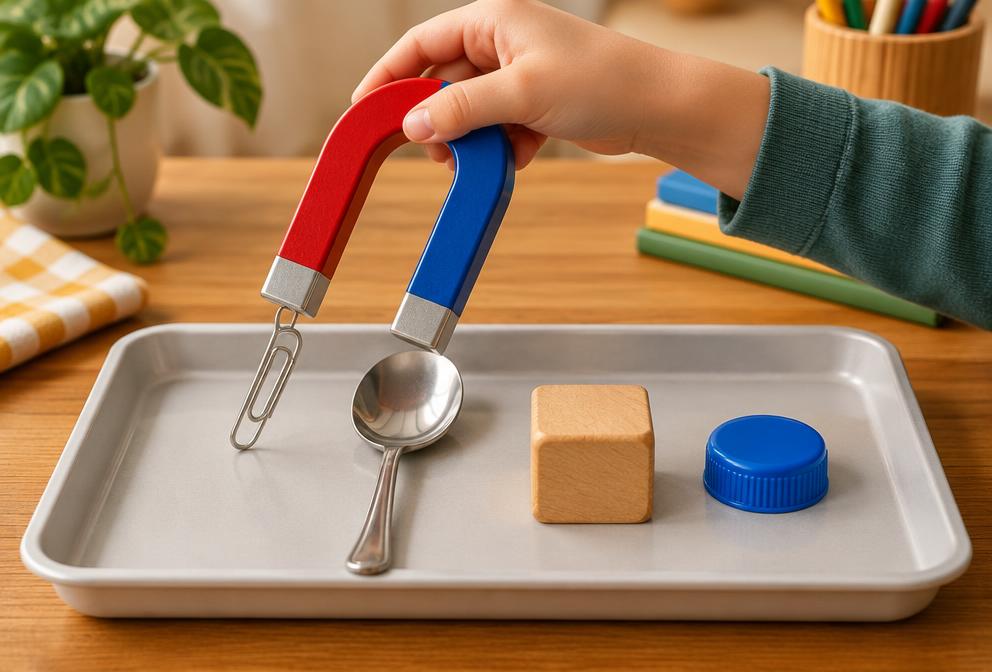
- 1 large, child-safe bar or horseshoe magnet
- A small basket or bag for collecting objects
- A notebook and pencil for a simple tally (optional)
- A tray to sort 'sticks' and 'does not stick' piles
Step by step
- 1
Give your child a large magnet and a basket, and set them loose on a chosen room.
- 2
Ask them to guess, before testing, whether each object will stick.
- 3
Test spoons, keys, coins, door handles, radiators and toys, sorting results into two trays.
- 4
Talk about what the 'sticks' pile has in common, leading them towards the idea of metal.
- 5
Try testing through paper, then through a tea towel, to see if the magnet still works.
- 6
Finish by drawing or listing everything that surprised them.
What kids learn
Predicting and testing
Guessing before testing gives children a chance to practise forming a simple hypothesis and checking it against reality.
Sorting and classifying
Grouping objects by a shared property is an early science and maths skill that this hunt makes concrete and physical.
Vocabulary building
Words like magnetic, attract and metal get used in a meaningful context rather than memorised from a list.
Make it easier
Limit the hunt to five pre-chosen objects on a tray so there is less searching and more testing.
Make it more challenging
Introduce the idea of magnetic strength by seeing how many paperclips their magnet can lift in a chain, or testing through increasing thicknesses of card.
Safety and supervision
- Small magnets are a serious choking hazard and should never be given to children who still mouth objects.
- Keep any small or pellet-style magnets away from children altogether; use only large single magnets for this activity.
- If a magnet is ever swallowed, treat it as a medical emergency and seek help immediately, since two magnets can pinch together inside the body and cause serious harm.
- Keep strong magnets away from electronics, credit cards and pacemakers.
Adult supervision is required for every activity on this site. Read our full child safety guidelines.
Pin this activity
A 2:3 vertical graphic, sized 1000×1500 for Pinterest. Save it for later or share it with another parent.
wondercraftkids.com
Magnet Discovery Hunt
Ages 3-7 · 20 min · no mess
Ages 3–7 · No mess
Suggested pin description
Magnet Discovery Hunt: A room-by-room hunt with a fridge magnet turns 'what will stick' into a proper hands-on science lesson. Ages 3–7, 25 minutes total, no mess. Full step-by-step instructions and a materials list at WonderCraft Kids.
Free download
Get the FREE 20 Screen-Free Activities Pack
Twenty printable activity cards for ages 2–8, sorted by time and mess level. One email, no spam, unsubscribe any time.
Frequently asked questions
Why do some metal objects not stick to a magnet?+
Only certain metals, mainly iron, nickel and cobalt, respond to magnets. Aluminium and copper, for example, will not stick even though they are metal.
What if my child tries to swallow a small magnet?+
Treat it as a medical emergency and get help straight away. This is exactly why this activity should only use one large magnet, never small loose pieces.