Paint Wooden Animals
Plain wooden animal shapes take paint well and turn into a shelf of characters your child actually designed.
By WonderCraft Kids Editorial Team, Editorial team · Updated 7 September 2026
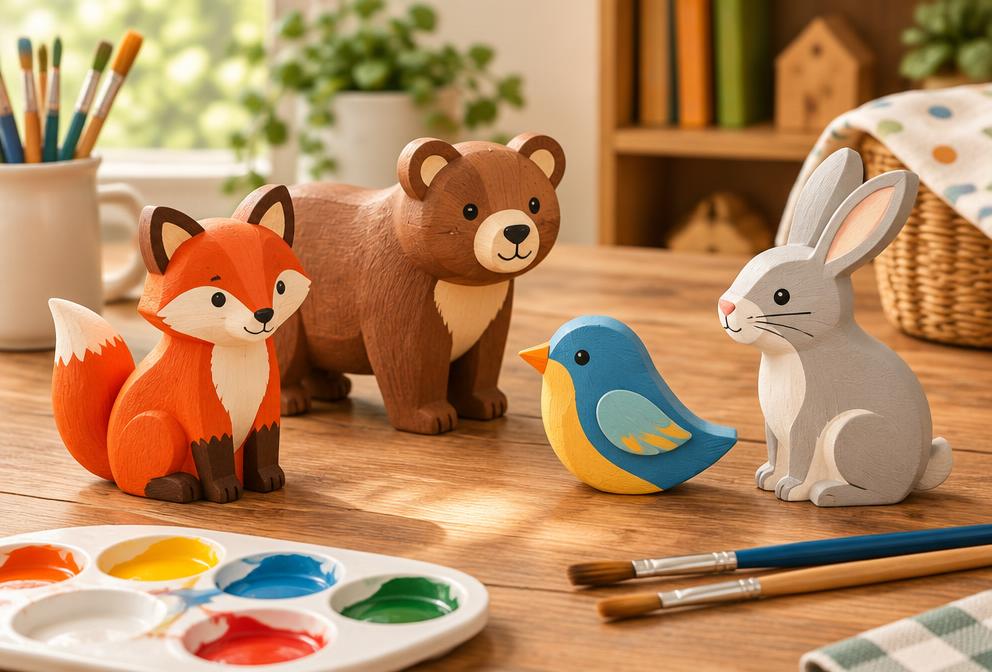
Unpainted wooden animals give children a solid, ready-made form to decorate, which removes the pressure of drawing an animal from scratch. A base coat, then dots, stripes or patterns of their own choosing, and within an hour there is a small painted menagerie drying on the windowsill. Wood takes paint more slowly than paper, so colours stay where you put them rather than bleeding.
What you need
- Plain wooden animal cutouts, one per child
- Acrylic or washable poster paint, 4-6 colours
- Fine and medium paintbrushes
- A paper plate or palette for mixing
- Newspaper or a wipe-clean mat
- A clear varnish or PVA glue for sealing (optional)
Step by step
- 1
Cover the table and set out one small blob of each paint colour on the palette.
- 2
Paint a base coat over the whole animal and leave it to dry for about 15 minutes.
- 3
Once dry, add a second colour for patterns such as spots, stripes or a coloured face.
- 4
Use a fine brush for small details like eyes, whiskers or a nose.
- 5
Leave flat to dry fully for at least an hour before handling.
- 6
If sealing, brush on a thin coat of watered-down PVA glue and leave to dry overnight.
What kids learn
Colour and pattern decisions
Deciding what a fictional-coloured animal should look like gives children a chance to practise creative decision-making.
Brush control on a hard surface
Wood is less forgiving than paper, so painting it can help children practise steadier, more controlled brushstrokes.
Working in layers
Waiting for a base coat to dry before adding detail can help children practise patience within a single project.
Make it easier
Offer two paint colours and a larger, simpler animal shape such as a fish or a whale, so a single base coat feels complete.
Make it more challenging
Give a set of five animals and ask your child to design a matching pattern theme across all of them, like the same spots or stripes.
Safety and supervision
- Choose paint labelled non-toxic and check the age guidance on the pot before use with younger children.
- Wooden pieces can have rough edges; a light sand beforehand prevents splinters.
- Acrylic paint does not wash out of clothing, so an apron or old shirt is worth using.
Adult supervision is required for every activity on this site. Read our full child safety guidelines.
Pin this activity
A 2:3 vertical graphic, sized 1000×1500 for Pinterest. Save it for later or share it with another parent.
wondercraftkids.com
Paint Wooden Animals
Ages 3-7 · 25 min · low mess
Ages 3–7 · Low mess
Suggested pin description
Paint Wooden Animals: Plain wooden animal shapes take paint well and turn into a shelf of characters your child actually designed. Ages 3–7, 30 minutes total, low mess. Full step-by-step instructions and a materials list at WonderCraft Kids.
Free download
Get the FREE 20 Screen-Free Activities Pack
Twenty printable activity cards for ages 2–8, sorted by time and mess level. One email, no spam, unsubscribe any time.
Frequently asked questions
Where do plain wooden animal shapes come from?+
Craft shops and haberdashery sections often stock unfinished wooden cutouts in animal shapes, sold by the piece or in mixed bags.
Do the painted animals hold up to play afterwards?+
A coat of watered-down PVA or clear varnish over the dried paint makes them much more resistant to chipping during play.