Salt Painting
Glue-and-salt lines turn watercolour into a raised, crystalline effect that spreads on contact.
By WonderCraft Kids Editorial Team, Editorial team · Updated 7 September 2026
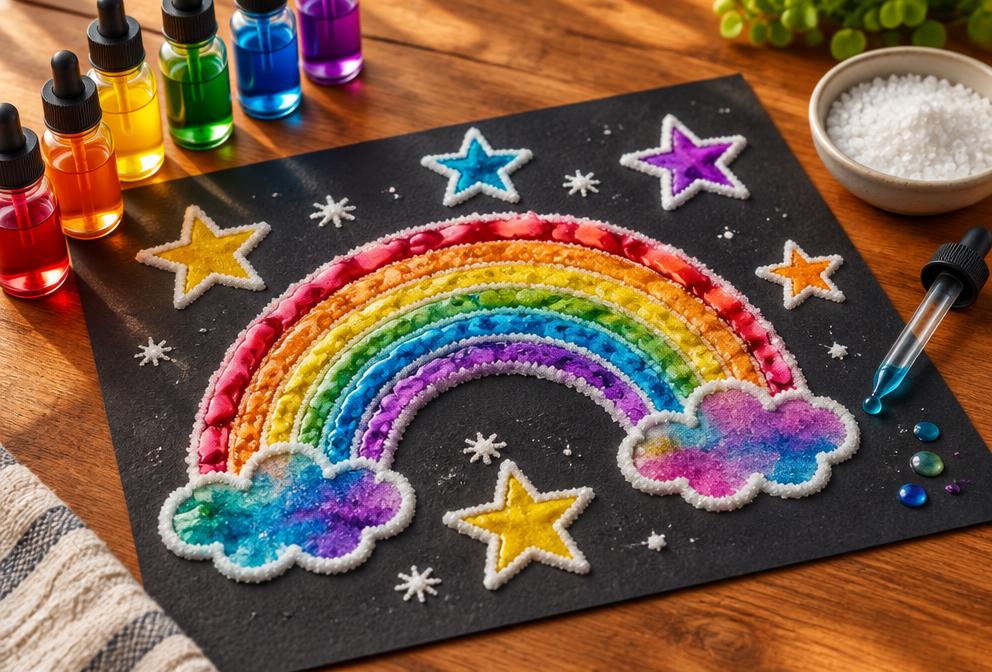
Salt painting is glue drawing crossed with a chemistry trick: children first draw with glue and cover it in table salt, then touch liquid watercolour to the salt and watch the colour wick sideways along every grain. The drawing stage is calm and controlled, the painting stage is fast and slightly unpredictable, and the two moods together hold attention for a full sitting.
What you need
- Thick paper or card, stiff enough not to buckle
- White glue in a bottle with a fine nozzle
- Table salt, about half a cup
- Liquid watercolour paint or food colouring mixed with water
- Small paintbrushes, one per colour
- A tray to catch excess salt
Step by step
- 1
Draw a simple outline in pencil first if your child wants a guide, such as a flower or a rainbow.
- 2
Trace over the lines with glue, working over a tray so mess is contained.
- 3
Sprinkle salt generously over the wet glue while it is still tacky, then tip off the excess.
- 4
Leave the glue to dry until it is firm to a light touch, about ten minutes.
- 5
Dip a paintbrush lightly into watery paint and touch it to the salt line rather than brushing it on.
- 6
Watch the colour travel along the salt on its own, and touch a new colour to a different spot.
- 7
Leave completely flat until dry, since the raised salt stays fragile while wet.
What kids learn
Cause and effect
Seeing colour wick along the salt without being brushed there gives a visible example of liquid moving through a material.
Fine motor control
Drawing a controlled glue line and later touching a brush precisely to it both demand a steadier hand than free painting.
Patience with process
Waiting for glue to dry before painting can help children practise a pause between one step and the next.
Make it easier
Pre-draw a simple large shape in glue for your child, so they move straight to salting and painting without needing to trace lines themselves.
Make it more challenging
Ask your child to plan a design with several separate glue sections in advance, then paint each in a different colour to see how far each one spreads.
Safety and supervision
- Table salt is not a choking hazard in normal use but is not for eating in quantity.
- Liquid watercolour can stain hands and clothing, so use an apron or old clothes.
- Keep the finished piece flat until fully dry to avoid smudging the raised salt lines.
Adult supervision is required for every activity on this site. Read our full child safety guidelines.
Pin this activity
A 2:3 vertical graphic, sized 1000×1500 for Pinterest. Save it for later or share it with another parent.
wondercraftkids.com
Salt Painting with Watercolour
Ages 4-8 · 25 min · some mess
Ages 4+ · Some mess
Suggested pin description
Salt Painting with Watercolour: Glue-and-salt lines turn watercolour into a raised, crystalline effect that spreads on contact. Ages 4+, 40 minutes total, some mess. Full step-by-step instructions and a materials list at WonderCraft Kids.
Free download
Get the FREE 20 Screen-Free Activities Pack
Twenty printable activity cards for ages 2–8, sorted by time and mess level. One email, no spam, unsubscribe any time.
Frequently asked questions
Why does the paint spread along the salt instead of staying put?+
The salt crystals draw the watery paint sideways by capillary action, the same effect that pulls water up a paper towel.
Can we use coloured salt instead of watercolour?+
Yes, that gives a different, drier effect: dye the salt first and skip the paint step entirely for a bolder, crunchier texture.